

A mid burst fade is a men’s haircut where the sides fade out in a rounded arc around the ear, starting near the temple, while the back keeps more length. It looks sharp, frames the face well, and works with almost any top, from a buzz cut to a mullet.
Most people like the look but freeze in the barber’s chair. Burst, taper, drop and skin all sound similar, and one wrong guess can leave you with a cut you never wanted. This guide clears that up. You will learn what the cut is, how it differs from neighbouring fades, which hair types suit it, the best styles to show your barber, and the exact words to use at your next appointment.
Key takeaways
- Mid describes where the fade starts (around the temple), not how short it gets.
- Burst describes the shape: a curved arc around the ear instead of a straight line.
- It suits most hair types, but the top style and finish (skin, shadow or guard) should match your hair density.
- Give your barber six details and a photo, and you will almost always get what you pictured.
- Plan a refresh every two to four weeks to keep the arc crisp.
What is a mid burst fade?
A mid burst fade is a fade haircut that begins at mid height on the sides of the head and curves around the ear in a semicircle. The hair is shortest right at the ear and temple area and grows longer as it moves up the head. The back and nape usually keep more length than they would in a standard fade.
That curved shape is what separates it from most other fades. A traditional fade runs in a level line around the whole head. A burst fade concentrates the short hair in one rounded zone, a bit like a sunburst spreading out from the ear.
What makes it “mid”?
The word “mid” tells your barber the height of the fade. It marks where the shortest hair stops and the longer hair begins.
- Low: starts just above the ear and sideburn.
- Mid: starts around the temple, roughly halfway up the side of the head.
- High: starts near the upper temple or higher, close to the crown curve.
Height is not the same as shortness. A mid fade can end at bare skin, at a shadow (a very short layer of stubble) or at a clipper guard. Those are separate choices, and your barber will ask about them.
Mid is the most popular middle ground. It shows clear contrast without exposing as much scalp as a high fade, and it leaves enough length on the sides to look balanced.
What does “burst” change?
“Burst” changes the shape and the back of the cut, not the height.
- The arc: the fade forms a rounded half circle around the ear rather than a straight guideline.
- The back: hair behind the arc is often left longer, which is why the cut pairs so well with mullets, curls and faux hawks.
- The focus: the ear becomes the centre of the design, so the cut looks sharper from the side.
Because the shape is freehanded in most cases, results depend on the barber’s skill. That is the main reason clear instructions and reference photos matter so much.
How does a mid burst fade compare with low, high, drop and taper fades?
The fastest way to pick the right cut is to separate two ideas: height (low, mid, high) and shape (burst, drop, straight, taper). Many people mix these up, and so do some online guides.
| Cut | Shape | Starts at | Contrast | Best for |
| Low burst fade | Curve around the ear | Just above the ear | Soft | First fades, office settings |
| Mid burst fade | Curve around the ear | Around the temple | Medium to strong | Most hair types and styles |
| High burst fade | Curve around the ear | Upper temple and above | Very strong | Bold looks with a full top |
| Regular mid fade | Level line around the head | Around the temple | Medium | Any top style, clean and classic |
| Drop fade | Curves down behind the ear to the nape | Varies | Medium to strong | A rounder silhouette |
| Burst taper | Short blend at the ear and neck only | Low | Subtle | Low maintenance |
Mid burst fade vs low burst fade

A low burst hugs the ear and leaves most of the side hair in place. A mid burst climbs toward the temple and removes more hair from the sides.
Choose low if you want a quiet curve that grows out gently. Choose mid if you want the arc to be clearly visible. Expect the mid version to need a fresh-up a little sooner, because more of the line is on show.
Mid burst fade vs high burst fade
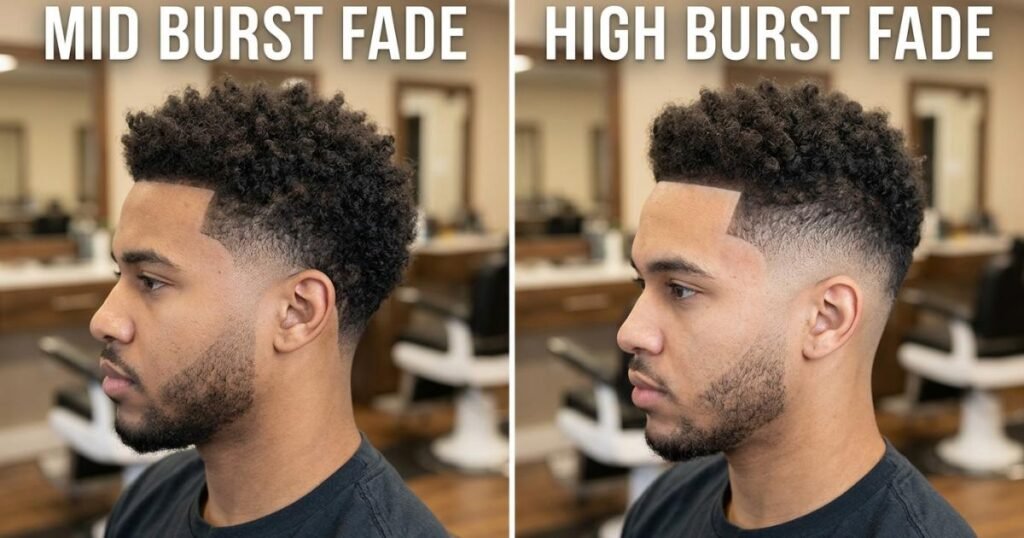
A high burst raises the arc close to the crown and creates the strongest contrast. It looks dramatic, but it asks more of your top hair. If the top is thin or short, a high burst can make it look sparse.
A mid burst is the safer middle choice. It still reads as a bold design, yet it keeps enough side length to balance a medium or fuller top.
Mid burst fade vs regular mid fade
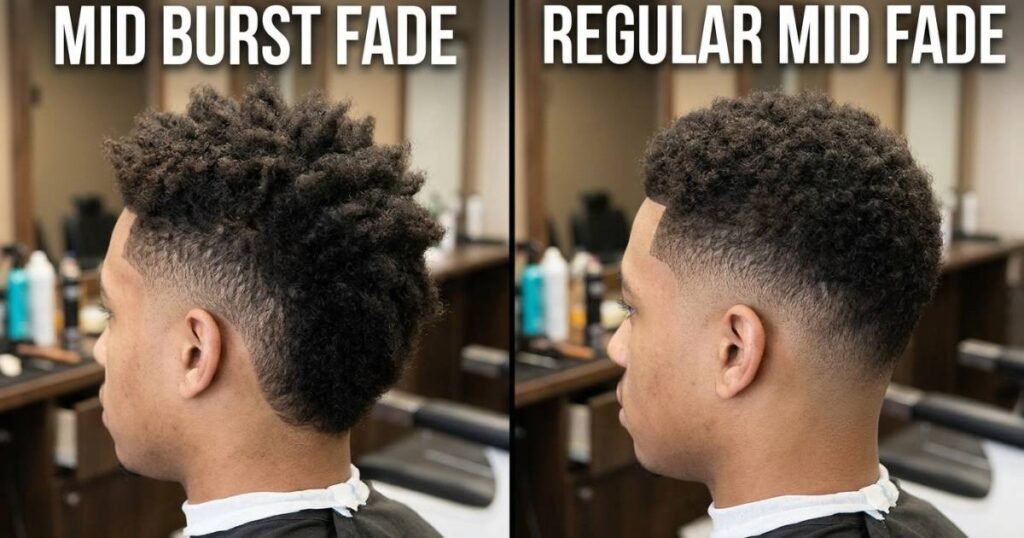
This is the most common mix-up. A regular mid fade runs level and wraps evenly around the head. A mid burst fade curves around the ear and usually keeps weight at the back.
A simple test: look at the cut from behind. If the fade line stays flat across the nape, it is a regular mid fade. If the shortest area forms a rounded zone at the ear and the back stays fuller, it is a burst.
A regular mid fade works with nearly any top. A burst fade is more of a feature, so it looks best when the top and back are styled to match.
Mid burst fade vs drop fade and burst taper
A drop fade follows the shape of the skull and dips lower behind the ear toward the nape. The fade continues all the way around, just on a curve. A burst fade stops its short area near the ear and keeps more length behind it.
A burst taper is a softer cousin. It tidies the hair around the ear and the neckline without taking the sides down very far, so there is less bare skin and less upkeep.
Barbers and websites use these names loosely. Ask your barber to point to where the short hair will start and stop. A photo removes the guesswork.
See also: Low Taper vs Low Fade: What’s the Difference, and Which Should You Choose?
Who does a mid burst fade suit?
A mid burst fade suits most men and teens because the barber can adjust the height, finish and top length to fit. The cut works best when the top style matches your hair texture and density.
What about face shape? Use these as loose guides, not rules:
- Oval: almost any version works.
- Round: keep extra height and volume on top to add length.
- Square: a softer finish and a textured top soften strong angles.
- Long or oblong: avoid piling height on top; choose a fringe or crop instead.
Straight hair
Straight hair shows every line, so a mid burst looks very clean but also reveals blending mistakes. A neat fade matters more here than on curly hair.
- Works well with crops, fringes, quiffs and textured tops.
- Keep at least a couple of centimetres on top so the hair has something to style.
- Check your crown: a strong cowlick can fight a short top, so tell your barber about it.
If your hair lies very flat, ask for texturising on top. It adds movement and stops the cut looking heavy.
Wavy and curly hair
Wavy and curly hair is a great match, because the burst leaves volume at the top and back while keeping the sides neat. The contrast makes curls look fuller.
- Leave enough length for the curl to form, usually a few centimetres or more.
- Ask your barber to cut curls dry or near dry so they can see the real shape.
- A mid burst with a curly top and a longer back gives a modern, relaxed look.
Wavy hair works well with a textured top or a loose fringe. Curly hair suits twists, a defined curl pattern or a short natural top.
Coily and Afro-textured hair
Coily and Afro-textured hair holds a fade line extremely well, which is why burst fades are so popular with tight curl patterns. The arc looks crisp against dense coils.
- Works with coils, twists, finger coils, a high top or a short sponge-style top.
- Pick a barber with proven experience on coily hair. Ask to see recent work.
- Ask about the finish. A shadow finish is gentler on sensitive skin than a bald skin finish.
Keep the scalp and sides moisturised so the line stays smooth and the skin stays comfortable.
Fine or low-density hair vs thick or dense hair
Density changes which version of the cut works best.
| Hair type | Best height | Best finish | Tip |
| Fine or low density | Low to mid | Shadow or a guard | Keep more weight on top so the sides do not look empty |
| Thick or dense | Mid or high | Skin, shadow or guard | Ask for texturising or thinning to avoid bulk |
Fine hair has less to balance bare sides, so a softer burst is usually more flattering. Thick hair can carry stronger contrast, but it grows out faster and needs more frequent trims to stay neat.
Best mid burst fade styles to show your barber
The fade itself stays the same. What changes the whole look is the top. Here are five styles worth bringing to your appointment.
Textured top or fringe
A short, choppy top with a forward fringe is the easiest style to wear every day. It works on straight and wavy hair and suits most face shapes.
- Ask for: a mid burst fade with a textured top, a few centimetres long, pushed forward.
- Style with: a matte clay or paste and a quick blow dry.
Curly top
A curly top with a mid burst is a strong choice for wavy, curly and coily hair. The neat sides make the curls stand out.
- Ask for: a mid burst fade with the curls left long enough to define, with the back kept fuller.
- Style with: a curl cream and a diffuser or air drying.
Burst fade mullet
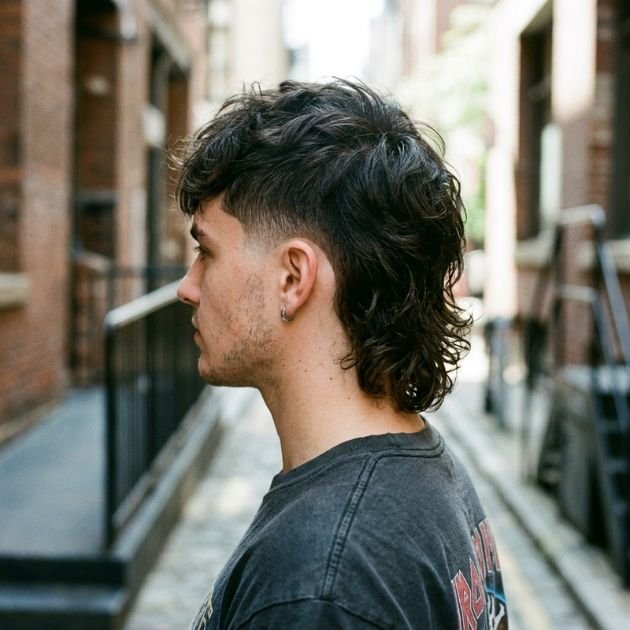
The burst fade mullet keeps the back long while the sides stay short around the ear. It is one of the most recognisable burst fade looks and has stayed popular for several years.
- Ask for: a mid burst fade with a mullet back, plus how long you want the nape to stay.
- Good to know: the back needs regular trims so the shape does not turn messy.
Buzz cut
A buzz cut with a mid burst fade is the lowest effort option. The top is clipped short and even, and the fade adds shape around the ear.
- Ask for: a buzz cut on top with a mid burst fade, and name the guard length you prefer.
- Good to know: it is easy to keep clean, but a short top shows scalp, so choose a softer finish if you have thinning hair.
See also: Low Taper Fade vs Mid Taper Fade: Which One Is Right for You?
French crop or faux hawk
A French crop has a short, forward fringe cut straight across. A faux hawk lifts the centre of the top into a ridge. Both pair well with a mid burst because the arc draws the eye upward.
- Ask for: a mid burst fade with a short crop or a longer centre for a faux hawk.
- Style with: a strong hold paste for the faux hawk and a light wax for the crop.
How to ask your barber for a mid burst fade?
A good request is short, specific and backed by a photo. The goal is to remove any room for guessing.
What to specify in your barber brief
Use this six point checklist.
- Height: say “mid” so the barber knows where the arc starts.
- Shape: say “burst” and ask for a rounded curve around the ear.
- Finish: choose skin, shadow or a guard length. Do not assume burst means skin.
- Back and nape: ask whether to keep it long, tapered or squared.
- Top: give the length and style, such as textured, curly or buzzed.
- Sideburns and beard: say how the fade should connect to them.
Here is a script you can adapt:
“I’d like a mid burst fade, curved around the ear, down to a shadow finish. Please keep the back longer and tapered at the nape. On top, I want about [length] with a [style]. Here is a photo of what I like.”
One more tip: ask the barber to repeat the plan back to you before clippers start. It takes ten seconds and prevents most mistakes.
Why reference photos matter?
The same words can mean different things to different barbers. A photo shows the arc, the finish and the back length instantly.
For best results:
- Bring a side view and a back view if you can.
- Choose photos of hair similar to yours in texture and density.
- Say what you like about the photo, such as the curve, the length or the finish.
- Avoid heavily filtered images, because lighting can hide the real fade line.
If your photo shows a different hair type, tell the barber. They can adjust the plan to suit your hair.
Do you need to know clipper guard numbers?
No. Most barbers will happily translate your goals into guard numbers. What helps more is describing the result: “skin at the ear,” “short stubble,” or “keep some length on the sides.”
If you do want a reference, a #1 guard leaves about 3 mm and a #2 about 6 mm, though sizes vary slightly by brand. Words like “shadow” and “skin” are usually clearer than numbers because they describe the finish you will see.
How to style and maintain a mid burst fade?
The fade gives structure, but daily styling and regular visits keep it looking sharp.
Styling by hair texture
- Straight hair: apply a small amount of matte clay or paste to damp hair and shape it with your fingers. Use a hair dryer for lift.
- Wavy hair: use a light cream or sea salt spray to boost texture, then air dry or diffuse.
- Curly hair: apply curl cream to wet hair, scrunch gently and dry with a diffuser. Avoid heavy brushing, which breaks up curls.
- Coily hair: moisturise daily, define coils with a leave in product and use a soft brush on the sides to keep the fade smooth.
Wash the hair regularly, but avoid heavy products building up around the fade line, because buildup can make the blend look dull.
How often does a mid burst fade need refreshing?
Most people need a refresh every two to four weeks. Hair grows about a centimetre a month on average, and the contrast fades first on the sides.
| Finish | Typical refresh |
| Skin | 2 weeks |
| Shadow | 2 to 3 weeks |
| Guard or taper | 3 to 4 weeks |
The shorter the finish, the sooner it shows regrowth. If you want fewer visits, go for a softer finish or a lower height.
What if a skin finish irritates your skin?
A bald finish can cause redness, razor bumps and ingrown hairs, especially on curly or coily hair and sensitive skin. If that happens, try these steps:
- Ask for a shadow finish instead of bare skin.
- Ask the barber to cut with the grain and avoid shaving against it.
- Apply a cool compress and a fragrance free moisturiser after the cut.
- Avoid picking or scratching the area.
- Book your next visit a little later, so the skin can settle.
If irritation keeps coming back, speak to a dermatologist. This guide is general information and is not medical advice.
FAQ’s
What is a mid burst fade?
It is a fade that starts around the temple and curves in an arc around the ear, with more length kept at the back.
Is a mid burst fade the same as a mid taper fade?
No. A mid taper fade runs in a straighter line around the head, while a mid burst curves around the ear.
How long should my hair be on top for a mid burst fade?
It can be any length, from a buzz cut to a long mullet, but a few centimetres works best for textured styles.
How often should I refresh a mid burst fade?
Every two to four weeks, depending on whether you choose a skin, shadow or guard finish.
What do I tell my barber to get a mid burst fade?
Say: “A mid burst fade curved around the ear, finished at shadow, with the back kept longer,” and show a photo.
Conclusion
A mid burst fade gives you a clean, curved fade around the ear, a balanced contrast and plenty of freedom on top. It suits straight, wavy, curly and coily hair, as long as the finish and top style match your density.
The key is clear communication. Say mid for height, burst for shape, choose your finish, describe the back and top, and bring a photo. Then plan a refresh every few weeks to keep the arc sharp.
If you are still unsure, start with a mid burst fade with a shadow finish. It is flexible, easy to adjust and a safe first step into the style. Your barber can always take it shorter next time.

Abu Huraira is the administrator of Faxhion Crown, a blog dedicated to hairstyles, fashion trends, and personal style. He is passionate about helping readers discover fresh hairstyle ideas, explore modern fashion, and find inspiration for everyday looks. Through Faxhion Crown, Huraira aims to share helpful styling tips, beauty inspiration, and fashion insights that help readers express their individuality with confidence.
2 thoughts on “Mid burst fade: what it is, who it suits and how to ask your barber”