

You sit down in the barber’s chair, and the question lands: “Burst fade or taper?” Both look sharp. Both keep the sides short. Yet they are not the same cut, and picking the wrong one can leave you with a haircut you did not want.
The short answer: a taper is a gradual shortening of hair along the sideburns and neckline. A burst fade is a rounded fade that curves around the ear like a half circle. A taper is subtle and classic. A burst fade is bolder and more shaped.
This guide breaks down how each cut looks from every angle, how it works on every hair texture, and what to say to your barber so you leave happy.
Burst Fade vs Taper: Ear, Temple and Nape Views
The easiest way to tell these cuts apart is to look at three spots on your head. Barbers call this a “zone check.”
| Area | Taper | Burst Fade |
| Ear | Hair shortens in a clean line that follows the natural hairline | Fade wraps around the ear in a curved arc |
| Temple | Soft, minimal change near the sideburn | Short and faded, with the arc starting here |
| Nape | Neckline tapers neatly, often leaving some length | Fade curves into the neck and can go very short |
Ear view: On a taper, your ear is framed by a tidy edge. On a burst fade, the ear sits inside a visible curve. From the side, a burst looks like a small sunrise behind your ear.
Temple view: A taper barely changes the temple area. A burst fade clears it, which makes the top look fuller and more defined by contrast.
Nape view: A taper cleans up the back with a gentle step down. A burst fade often rounds into the neckline, so from behind, the shape stands out. Front-facing, a burst can be hard to spot at all, which surprises many first-timers.
What is a taper?
A taper is a haircut where the hair gets gradually shorter toward the sideburns and the back of the neck. The change in length is smooth and subtle, and the hair does not usually go down to bare skin.
Think of it as a neat finish rather than a dramatic statement. A taper is one of the most traditional men’s cuts, and it works with almost any top style, from a crew cut to a side part.
Common taper types:
- Low taper: starts near the ear and neckline. Very clean and conservative.
- Mid taper: starts a bit higher on the sides. A balanced everyday choice.
- High taper: starts closer to the temple. More noticeable contrast.
Why people choose it:
- It looks natural and refined.
- It leaves more hair, so there is less risk of a harsh result.
- It grows out gracefully.
What is a burst fade?
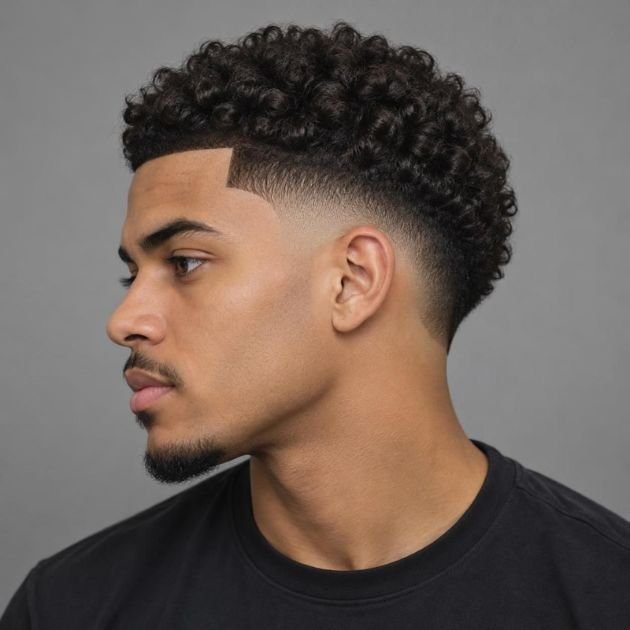
A burst fade is a fade that curves in a half circle around the ear and flows into the neckline. The hair is cut shortest at the edge of the arc and gets longer as it moves away from it.
The word “burst” describes how the fade seems to radiate out from the ear. The back of the head often keeps more length than the sides, which is why the cut pairs so well with longer styles on top.
Burst fades are often paired with:
- Mohawks and faux hawks
- Mullets
- Curls, twists and textured crops
- Longer, swept-back tops
- Beards, where the burst blends into the sideburn
Height options:
- Low burst: the arc stays close to the ear. Subtle and easier to wear to the office.
- Mid burst: the most popular choice. Visible but balanced.
- High burst: the arc climbs higher, giving a bold, graphic look.
A burst fade can also be a skin fade, meaning it goes down to bare skin at the edge, or it can stop at a very short guard length.
What Does “Burst Taper” Mean?
A burst taper combines the burst shape with the softer blend of a taper. You get the curve around the ear, but the fade does not drop to skin. The result sits between the two cuts.
It is a handy middle path. You still get the rounded outline that makes a burst fade stand out, but the transition is gentler and looks more natural.
Burst taper vs burst fade:
- Burst taper: softer, keeps some length, looks lower contrast.
- Burst fade: sharper, often goes to skin, looks higher contrast.
If you are unsure which to try first, a burst taper is a low-risk starting point. You can always go shorter next visit.
Burst fade vs taper fade: which looks better for your hair texture?
Texture matters more than most guides admit. The same cut can look very different on fine straight hair and on tight coils, because texture controls how the top sits, how the blend shows, and how fast the shape fades.
Straight hair

Straight hair shows every line, so any unevenness in the blend is easy to spot.
- Taper: looks tidy and classic, especially with a side part or textured crop.
- Burst fade: the arc looks crisp, but it needs a skilled blend to avoid a stripe-like edge.
- Tip: if your hair is fine, a taper hides thinness better. Thick straight hair carries a burst well.
Wavy hair

Wavy hair has natural movement, and both cuts work with it.
- Taper: keeps the waves soft and relaxed.
- Burst fade: frames the waves nicely and makes a messy, textured top look intentional.
- Tip: keep enough length on top for the waves to form. Too short and they flatten into frizz.
Curly hair
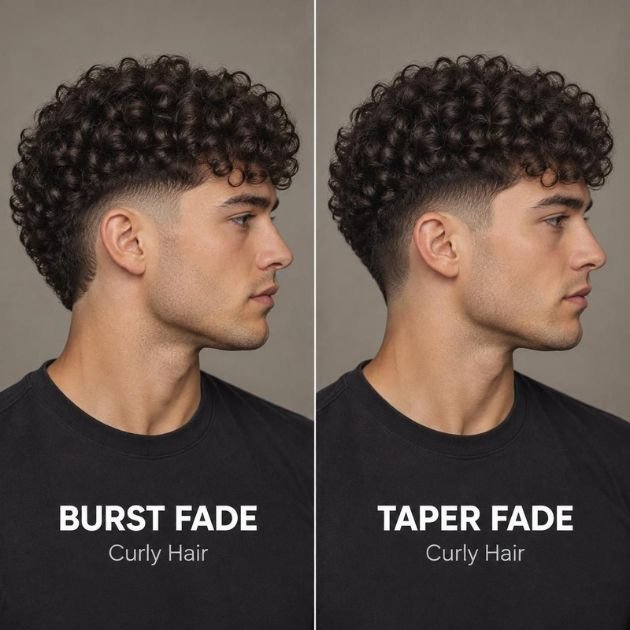
Curly hair and burst fades are a popular pair. The tight shape of the curls sits above the clean arc, and the contrast is strong.
- Taper: good for a neat, balanced look with defined curls.
- Burst fade: the star choice for curls. The curls stay full on top and the sides stay sharp.
- Tip: ask the barber to leave the back full if you want a rounded curly silhouette.
Coily hair
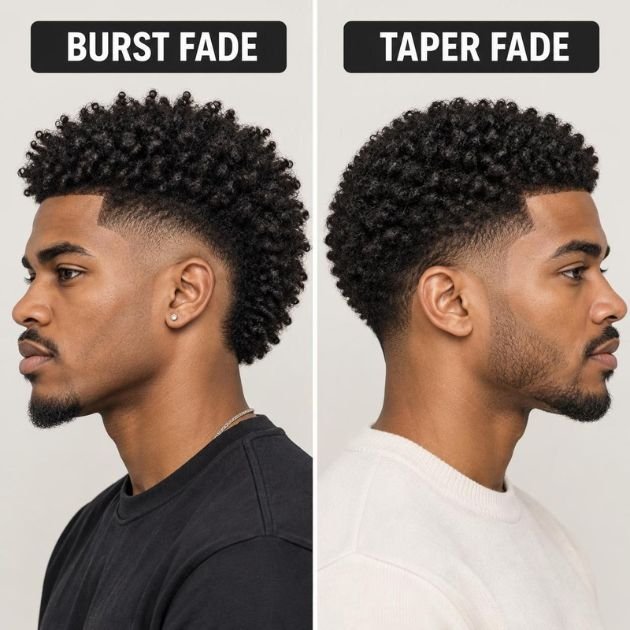
Coily hair holds a sharp edge better than any other texture, so burst fades look especially clean here.
- Taper: a polished, professional option that keeps the edges tidy.
- Burst fade: the curve stays crisp and clear for weeks, and it pairs well with twists, high-top styles and shaped line-ups.
- Tip: razor bumps can occur on very short fades, so tell your barber about skin sensitivity.
What about face shape?
Face shape affects which cut balances your features. Here is a simple guide.
- Oval face: you can wear almost anything. A burst fade adds a modern edge.
- Round face: a mid or high burst adds height and structure. A taper with volume on top also lengthens the face.
- Square face: a taper softens strong angles. A low burst can also work if the top has texture.
- Heart-shaped face: a low taper or low burst keeps width near the jaw and avoids a top-heavy look.
- Long or oblong face: avoid a very high burst. A low taper keeps proportions even.
Rule of thumb: the higher the fade, the more it draws the eye upward. Use that to add height to a round face or avoid extra height on a long one.
Which is more professional?
A taper is usually the safer pick for conservative workplaces. Its gradual shape reads as classic and neat, and it rarely raises eyebrows.
A burst fade can be professional too, as long as you keep it low and the top is tidy. A low burst taper with a neat part looks sharp in an office. A high burst skin fade with a mohawk is more of a statement.
A quick check:
- Corporate, legal, banking: low taper or low burst taper.
- Creative, tech, hospitality: low or mid burst fade.
- Military or school rules: check the grooming policy first, since some limit skin fades.
Maintenance and grow-out
Both cuts look best when fresh, and the sides show growth quickly.
| Taper | Burst Fade | |
| Barber visit | Every 3 to 5 weeks | Every 2 to 3 weeks |
| Daily styling | Top only | Top only |
| Grow-out look | Soft and natural | Arc softens and looks blurry |
| Cost over time | Lower | Slightly higher |
Tips to extend the cut:
- Ask for a slightly longer starting guard if you want it to last.
- Keep the neckline clean between visits with a trimmer, but do not touch the arc yourself.
- Use a light product on the top only. The sides hold their own shape.
- Moisturize the scalp, especially after skin fades.
Grow-out stages: a taper simply looks like a regular haircut as it grows. A burst fade loses its curve first, so it can look uneven around week four. If you want to grow it out fully, a burst taper is easier to manage than a skin burst.
What to tell your barber?
Barbers work faster and better when you give them exact terms. Photos help, but words add precision.
What to say in the chair?
Use these ready-made scripts:
- For a taper: “Low taper on the sides and back. Keep the length on top. Natural neckline.”
- For a burst fade: “Mid burst fade around the ear, faded to skin. Keep the back longer and blend it in.”
- For a burst taper: “Low burst taper. Curve around the ear, but do not take it to skin.”
What to bring to the appointment
Do these before the clippers come out:
- Show a photo from the side and back. Burst fades are hard to judge from the front.
- Name the height: low, mid or high.
- Say the finish: skin, shadow or guard number.
- Mention the top length so the barber can plan the blend.
- Ask about the neckline: blocked, rounded or tapered.
Common mistakes
Avoid these errors that lead to a disappointing cut:
- Saying “fade” without details. This can mean ten different cuts.
- Choosing a high burst for a long face. It stretches the shape.
- Forgetting about the back. The arc must blend into the neckline, so ask how it will look from behind.
- Skipping the skin check. Very short fades can cause irritation on sensitive skin.
- Waiting too long between cuts. Burst fades lose shape fast.
- Trying to fix the arc at home. One wrong pass can ruin the curve.
Compare your preferences
Not sure what to pick? Match yourself to a column.
| If you want… | Choose |
| A classic, understated look | Taper |
| A bold shape that stands out from the side | Burst fade |
| The curve without going to skin | Burst taper |
| The lowest maintenance | Taper |
| To pair with a mohawk, mullet or curls | Burst fade |
| A safe office look | Low taper or low burst taper |
Frequently asked questions
What is the main difference between a burst fade and a taper fade?
A burst fade curves around the ear in a half circle, while a taper fade shortens hair gradually along the sideburns and neckline.
Is a burst fade the same as a burst taper?
No. A burst fade often goes to skin, while a burst taper keeps the curve but leaves a softer, longer blend.
Which is better for curly hair?
A burst fade usually suits curly hair best, because the sharp arc contrasts well with full curls on top.
How often should I get a burst fade?
Most people need a touch up every two to three weeks to keep the curve crisp.
Can I wear a burst fade to work?
Yes. A low burst or burst taper with a neat top is professional in most workplaces.
Which cut is easier to grow out?
A taper grows out more naturally, since it has no defined curve to lose.
Conclusion
The burst fade and the taper fade share the same goal: short, clean sides with a longer top. The difference is in the shape and the intensity. A taper is gradual, classic and easy to live with. A burst fade is rounded, bold and made to be seen from the side.
If you want the safe, timeless option, go with a low taper. If you want a statement shape, especially with curls, coils, a mohawk or a mullet, go with a burst fade. If you want a middle ground, ask for a burst taper.
Save a photo from the side and back, name your height and finish, and your barber will take care of the rest.
Related Hairstyles:
Low Taper vs Low Fade: What’s the Difference, and Which Should You Choose?
Burst Fade Haircuts: 13 Trendy Styles for Men in 2026
Blowout Taper Haircut: Styles, Types, and How to Get the Look

Abu Huraira is the administrator of Faxhion Crown, a blog dedicated to hairstyles, fashion trends, and personal style. He is passionate about helping readers discover fresh hairstyle ideas, explore modern fashion, and find inspiration for everyday looks. Through Faxhion Crown, Huraira aims to share helpful styling tips, beauty inspiration, and fashion insights that help readers express their individuality with confidence.