

The mid taper fade Edgar cut is a short, sharp haircut that pairs a blunt, straight fringe with sides that fade smoothly from short to shorter. It sits in the sweet spot between a bold high fade and a soft low taper, which is why so many men ask for it by name.
This guide covers eight real style variations, how to match the cut to your hair type, face shape, and age, the exact guard numbers to give your barber, and the mistakes that ruin the look. You will also find a maintenance plan and a quick comparison with similar cuts, so you walk into the shop knowing what to say.
Quick answer:
A mid taper fade Edgar cut has a 1 to 1.5 inch blunt fringe on top, with sides that start near the skin at the nape and blend up to about a #3 or #4 guard around temple height. Plan on a barber visit every 2 to 3 weeks to keep the lines crisp.
Mid Taper Fade Edgar Cut Explained: What Makes It Different?
The Edgar cut, also called the takuache cut in some communities, is built around one signature feature: a straight, horizontal fringe that sits across the forehead. The top is cropped short and cut blunt, almost like a Caesar cut with a heavier, more deliberate front line.
The “mid taper fade” part describes the sides. Here is what each piece means:
- Taper: The hair gets gradually shorter toward the neckline and around the ears. It leaves the hairline looking clean without removing all the weight.
- Fade: The blend goes shorter, often down to the skin, so the shift is smoother and more dramatic.
- Mid: The blend begins around the temple or just above the ear, roughly halfway up the side of the head.
So what sets this version apart? A high fade pulls attention upward and looks very bold. A low taper is subtle and easy to grow out. The mid version splits the difference. It frames the fringe well, suits most head shapes, and still looks tidy at the office or school.
Three details define a good one:
- A clean fringe line. Straight, even, and sitting just above the brows.
- A smooth blend. No visible steps or patches between guard lengths.
- A sharp outline. The edge-up around the temples and neck gives the cut its crisp, finished feel.
8 Best Mid Taper Fade Edgar Cut Styles
Every variation below keeps the same core structure. What changes is the texture, the length, and the extra detail. Pick the one that fits your hair and your daily routine.
Classic Mid Taper Edgar Cut

This is the version most barbers picture when you say the name. The top is cropped to about an inch, the fringe is cut flat and blunt, and the sides blend from skin or a #0 up to a #3 at the mid point.
- Best for: Men who want the original look without extras.
- Styling: Comb the hair forward, add a pea-sized amount of matte paste, and set the fringe with your fingers.
- Why it works: It is clean, balanced, and easy to explain to any barber.
Edgar Cut with Straight Hair

Straight hair is the easiest canvas for this cut because the fringe falls flat on its own. The line stays crisp with very little product.
- Best for: Men with thick or medium straight hair.
- Watch out for: Fine straight hair can look flat or see-through at the front. Ask for a slightly longer fringe, about 1.5 inches, so it has body.
- Styling: Use a light sea salt spray or powder for grip. Skip heavy gels, which weigh the fringe down.
See Also: 15 Best Mid Taper Fade Asian Haircuts for Men (2026)
Wavy Edgar Cut

Wavy hair adds movement to the fringe, so the blunt line looks a little softer and more natural. The waves break up the edge in a flattering way.
- Best for: Men with loose or medium waves.
- Ask for: Slightly longer length on top, around 2 inches, so the wave pattern shows.
- Styling: Apply a curl cream or light mousse to damp hair, then air dry or diffuse on low.
Textured Edgar Cut
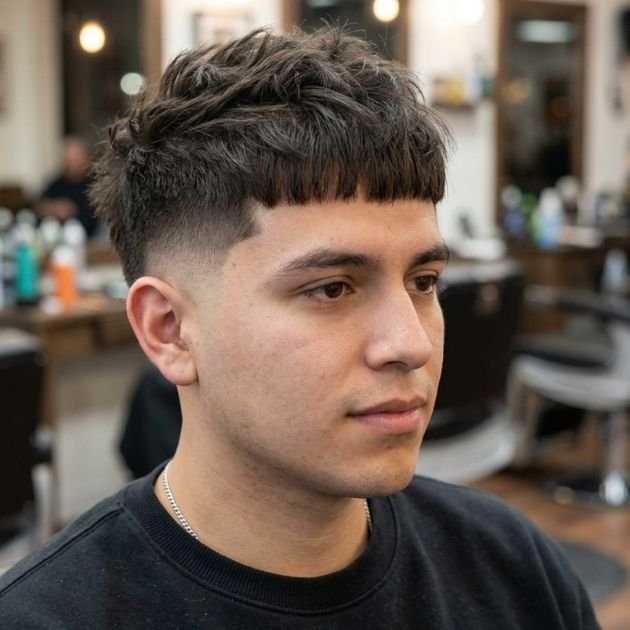
Instead of a razor straight edge, the barber point cuts the fringe to create a choppy, lived in finish. The result looks relaxed but still deliberate.
- Best for: Men who find the classic version too stiff.
- Ask for: “Point cut the fringe for texture, keep the length even.”
- Styling: Matte clay, worked through with fingertips, gives a messy but controlled look.
Curly Edgar Cut

Curls give the Edgar cut volume and a strong visual contrast against the faded sides. The fringe forms a rounded curtain of curls rather than a flat line.
- Best for: Men with type 3 and type 4 curls.
- Ask for: A longer top of 2 to 3 inches, with no over thinning. Curls shrink as they dry, so the barber should cut with that in mind.
- Styling: Leave in conditioner or curl cream on wet hair. Avoid brushing dry curls.
Edgar Cut with Design

A hair design adds personality to the cut. This can be a single shaved line, a small geometric shape, or a part line cut above the ear.
- Best for: Men who want a standout look and have a skilled barber.
- Tip: Keep it to one design element. A busy pattern competes with the fringe, which should stay the focal point.
- Reality check: Designs fade fast. Expect to refresh them every 1 to 2 weeks.
Edgar Cut with Beard Connect

Here the fade on the sides flows into the beard, so the head and face read as one clean shape. The mid taper pairs well because it lines up naturally with the sideburn.
- Best for: Men with medium to full beards.
- Ask for: “Blend the mid taper into the beard at the sideburn, and keep the cheek line natural.”
- Upkeep: Beard lines grow out quickly, so budget for frequent touch ups.
Short Fringe Edgar Cut

This version trims the fringe to about half an inch to 1 inch. It still has the blunt line, but it needs almost no styling and holds shape for longer.
- Best for: Busy men, students, and anyone who wants a wash and go routine.
- Why it works: The short length resists flopping, so the fringe stays put without product.
- Trade off: There is less room for texture or styling changes.
Why the Edgar Cut Took Over in 2026?
The Edgar cut has been climbing for several years, and a few clear reasons explain why it keeps its spot among the most requested short men’s styles.
- It reads well on camera. The blunt fringe and crisp fade look sharp in photos and short videos, which fuels sharing on social platforms.
- It fits many hair types. Straight, wavy, and curly hair each have a workable version.
- It bridges casual and polished. A mid taper looks tidy enough for work while the fringe keeps a modern edge.
- It is easy to describe. A short list of terms (blunt fringe, mid taper, edge up) gives barbers a clear brief.
- Short hair is practical. Men who want less time styling are drawn to cuts that look finished right out of the chair.
The mid taper has become the preferred middle ground. Many men now find a high fade too stark and a low fade too soft, so the in between version feels like a safe, modern choice.
Pros and Cons: What You’re Signing Up For
No haircut suits everyone. Here is an honest look at both sides.
Pros
- Quick daily styling, often under two minutes
- Works with straight, wavy, and curly textures
- Frames the face and balances most head shapes
- Looks clean in professional and casual settings
- Easy to grow out into a longer crop or a different fade
Cons
- The fade loses sharpness within 10 to 14 days
- A bad fringe line is obvious and hard to fix
- Cowlicks at the front hairline can fight the straight cut
- Regular barber visits add up over a year
- Very thin or receding hairlines may need a modified fringe
If you can commit to a trim every two to three weeks, the cut rewards you. If you cannot, choose the low maintenance version or a lower taper that grows out more gracefully.
Choosing by Hair Type: Where the Fringe Line Holds Best
Hair texture decides how the fringe behaves. Match the cut to your natural pattern instead of fighting it.
Straight Hair
Straight hair holds a blunt line better than any other type. The fringe lies flat, so the cut looks sharp with very little effort.
- Keep the fringe near 1 to 1.5 inches.
- Use matte paste or powder for hold.
- If your hair is fine, ask for a bit more length for density.
Wavy Hair
Waves add softness and movement. The fringe will not be perfectly flat, but that natural bend looks relaxed and modern.
- Cut slightly longer, around 2 inches.
- Ask for point cutting to control bulk.
- Style on damp hair with a light cream to define the pattern.
Curly Hair
Curly hair turns the Edgar cut into a voluminous, textured look. The fade contrast is the star here.
- Keep 2 to 3 inches on top so curls can form.
- Avoid thinning shears, which cause frizz.
- Moisturize regularly. Dry curls lose definition fast.
Face Shape Matchups
The mid taper is flexible, but small tweaks to fringe length and fade height help the cut flatter your features.
Oval Face
Oval faces suit almost every version. The classic mid taper Edgar works without changes.
Round Face
Choose a slightly longer top and a clean, defined fade to add vertical lines. Avoid a very short, flat fringe that makes the face look wider.
Square Face
The strong jaw already provides structure. A textured fringe softens the angles, and a classic mid taper keeps things balanced.
Heart-Shaped Face
A slightly longer fringe covers a wider forehead and balances a narrower chin. Keep the sides tight but avoid a fade that goes too high.
Long Face
A short, blunt fringe shortens the look of the face. Keep the top compact and avoid adding height.
Diamond Face
A textured fringe softens prominent cheekbones. Ask for medium length at the front so the forehead does not look too narrow.
Rectangular Face
A heavier, straight fringe reduces the length of the face. Skip tall, voluminous styling on top.
Age Group Breakdown
Teenagers
Teens often prefer the bolder versions, like the textured or designed Edgar cut. Check school dress codes before adding shaved lines. A short fringe version is a good starting point for a first fade.
Young Men
Men in their twenties and early thirties can experiment freely. Wavy, curly, and beard connect versions all work well, and a bit of product adds polish for nights out.
Professional Men
Choose the classic or short fringe version with a soft mid taper. Keep the fringe tidy, skip designs, and book regular trims so the neckline stays sharp. This looks neat in most workplaces without feeling dated.
Talking to Your Barber: The Exact Guard Numbers
Clear instructions save you from guesswork. Guard numbers vary slightly between clipper brands, so treat these as a solid starting point and let your barber adjust.
| Area | Typical Setting |
| Bottom of the fade (nape and sideburn) | Skin (foil shaver) or #0 to #0.5 |
| Mid point of the blend (around temple) | #2 to #3 |
| Top of the taper line | #3 to #4 |
| Fringe length on top | 1 to 1.5 inches (2.5 to 4 cm), cut blunt |
| Neckline | Blocked, rounded, or tapered, your choice |
A script you can use: “I would like a mid taper fade Edgar cut. Skin or a zero at the bottom, blending to a number 3 around the temple. Leave about an inch and a quarter on top, cut straight across the fringe, and give me a clean edge up.”
A few extra tips:
- Bring a photo, ideally from the front and the side.
- Mention your hair type so the barber can plan the fringe.
- Say whether you want a rounded or square neckline.
Video Guide: Watch the Fringe Get Cut
A short tutorial can make the process clearer before your appointment. Search for a barber demonstration of a mid taper Edgar cut, and watch for these steps:
- Sectioning: The barber separates the top from the sides.
- Fade work: Clippers start at the lowest guard and move up with a flicking motion.
- Blending: A scissor over comb or a clipper over comb tool removes lines between guards.
- Fringe cut: The hair is combed forward and trimmed straight across, often with the head tilted slightly down.
- Edge up: A trimmer cleans the temples, hairline, and neck.
If you cut your own hair, note how the barber checks the line from several angles. Keeping the fringe even is the hardest part to get right at home.
Common Mistakes That Ruin an Edgar Cut
Most bad Edgar cuts come from a few repeat errors. Avoid these and you are ahead of the game.
- Cutting the fringe too short. Once it is gone, you have to wait for it to grow back.
- Choosing the wrong fade height. A high fade on a round face or a very low taper on a long face can throw off the balance.
- Ignoring your cowlick. A strong crown or front whorl can push the fringe sideways. Tell your barber early.
- Skipping touch ups. The cut looks best in its first 10 days.
- Using heavy products. Thick gel or wax weighs down the fringe and makes it look greasy.
- Thinning curly hair too much. It leaves the top frizzy and uneven.
- Overcomplicating the design. Multiple lines or patterns steal attention from the fringe.
Maintenance Reality Check
The cut is simple to style, but it does need regular care.
Fringe Trim Frequency
Book a trim every 2 to 3 weeks. The sides fade out of shape fast, and the fringe starts curling or splitting as it grows. If you want the sharpest look, aim for every two weeks. If you are fine with a softer line, three weeks is enough.
Daily Styling
Your routine takes about two minutes:
- Start with towel dried or fully dry hair.
- Take a pea sized amount of matte paste, clay, or cream.
- Warm it between your palms.
- Push the hair forward and shape the fringe with your fingers.
- Finish with a light spray if you need extra hold.
Washing Routine
- Wash 2 to 3 times a week with a gentle shampoo. Daily washing can dry out the scalp.
- Use conditioner on wavy or curly hair.
- Rinse with lukewarm water to reduce frizz.
- Moisturize the faded areas lightly to prevent flaking on exposed skin.
Mid Taper Edgar Cut vs Other Styles
People often confuse the Edgar cut with similar short styles. These comparisons make the differences clear.
Edgar Cut vs French Crop
Both have short sides and a fringe, but they differ in how the fringe is cut.
| Feature | Edgar Cut | French Crop |
| Fringe shape | Straight, blunt, heavy | Short, textured, often slightly uneven |
| Top length | 1 to 1.5 inches | Around 1 to 2 inches, more tapered at front |
| Overall mood | Bold and structured | Relaxed and casual |
| Styling | Minimal, clean line | Textured, tousled finish |
The Edgar cut makes a stronger statement. The French crop is softer and easier to wear in more traditional settings.
Edgar Cut vs Standard Fringe
A standard fringe can be any length, parted, swept, or layered. The Edgar fringe is always cut straight across the forehead and paired with a fade or taper. That strict, geometric front line is what separates it from a regular fringe haircut.
Frequently Asked Questions
What is a mid taper fade Edgar cut?
It is a short haircut with a blunt, straight fringe and sides that blend from short to shorter, starting around the temple.
How long should the fringe be on an Edgar cut?
Most barbers cut it between 1 and 1.5 inches, or up to 3 inches for wavy and curly hair.
What guard number should I ask for?
Ask for skin or a #0 at the bottom, blending up to about a #3 at the mid point.
How often should I get my Edgar cut refreshed?
Every 2 to 3 weeks keeps the fade and fringe line sharp.
Does the Edgar cut work on curly hair?
Yes. Keep 2 to 3 inches on top and avoid heavy thinning so the curls form naturally.
Is the Edgar cut good for professional settings?
Yes, if you choose the classic or short fringe version with a soft mid taper and skip the designs.
What is the difference between a taper and a fade?
A taper shortens gradually and leaves some length, while a fade usually goes down to the skin.
Which face shapes suit the Edgar cut best?
Oval, square, and heart shaped faces suit it easily, and other shapes work with small fringe and fade height adjustments.
Conclusion
The mid taper fade Edgar cut earns its popularity by being sharp, flexible, and practical. Whether you go classic, wavy, curly, or add a beard blend, the formula stays the same: a clean blunt fringe, a smooth mid taper, and a crisp edge up.
Start with your hair type and face shape, give your barber exact guard numbers, and plan regular trims. Do that, and you will leave the chair with a cut that looks deliberate every day, not just on day one.

Abu Huraira is the administrator of Faxhion Crown, a blog dedicated to hairstyles, fashion trends, and personal style. He is passionate about helping readers discover fresh hairstyle ideas, explore modern fashion, and find inspiration for everyday looks. Through Faxhion Crown, Huraira aims to share helpful styling tips, beauty inspiration, and fashion insights that help readers express their individuality with confidence.
3 thoughts on “8 Best Mid Taper Fade Edgar Cut Styles for Men (2026)”