

A mid taper fade textured fringe is a short haircut with sides that blend from tight to longer around the temple, topped with a piece-y, forward-falling fringe. It looks sharp without looking stiff. That balance is why barbers keep getting the same request in 2026.
This guide covers eight styles, the exact guard numbers to show your barber, and how to match the cut to your hair type, face shape and age. I also cover the mistakes that quietly flatten texture, since those decide whether the cut works on a Tuesday morning and not just in the chair.
Quick answer:
Ask for a mid taper on the sides, 2 to 4 inches left on top, point cut for texture, and a fringe that falls forward. Style it with matte clay or sea salt spray on towel-dried hair.
8 Best Mid Taper Fade Textured Fringe Styles
Each style below uses the same mid taper base. The change happens on top: length, volume, wave pattern and detailing. Pick the one that fits the hair you already have, not the hair in a photo.
Classic Textured Fringe

This is the reference version. The sides taper cleanly from the temple, and the top sits at about 2 to 3 inches with light point cutting. The fringe lands just above the brows.
- Best for: Straight to slightly wavy hair, first-time fringe wearers
- Styling: Matte clay, fingers only, push forward and slightly to one side
- Why it works: Short enough to forgive a bad hair day, long enough to look styled
See Also: 8 Best Mid Taper Fade Afro Styles for Men (2026)
Choppy Textured Fringe

The choppy version uses heavier razor or scissor work so the ends separate into visible pieces. It reads more rugged and a little undone.
- Best for: Medium to thick straight hair that needs weight removed
- Styling: Dry paste or fiber cream, twisted between the fingertips
- Watch out: Over-thinning on fine hair leaves gaps instead of texture
Textured Fringe with Volume
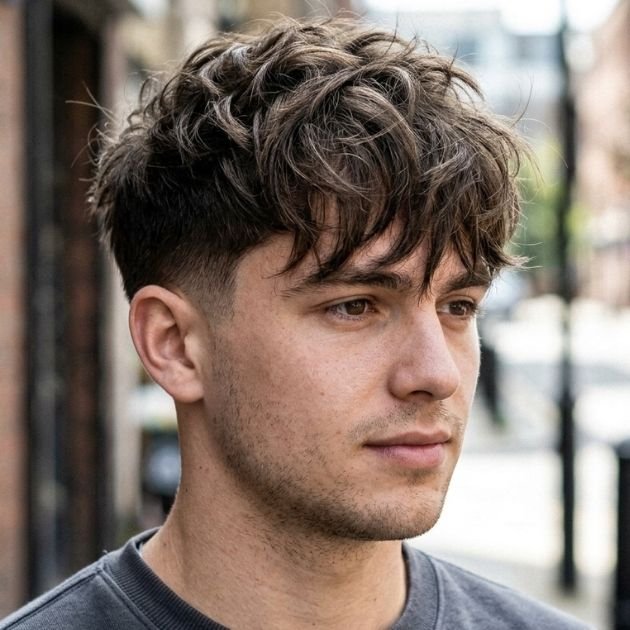
Here the top is left closer to 3 or 4 inches, with the front lifted and angled forward. The extra height balances the clean sides and adds presence.
- Best for: Medium to thick hair, narrower faces
- Styling: Pre-styling spray, blow dry upward at the roots, finish with clay
- Why it works: Lift at the crown makes the taper look more deliberate
Textured Fringe with Blowout

The blowout adds airy, brushed-up movement. Think full, soft and slightly swept, with the taper keeping the outline tidy.
- Best for: Straight and thick hair that holds a dryer shape
- Styling: Blow dry with a vent brush, then use a light-hold powder or cream
- Watch out: It needs five to ten minutes of dryer time most mornings
See Also: Mid Taper Fade Buzz Cut: Styles, Clippers & At-Home Guide (2026)
Wavy Textured Fringe

Waves do half the work for you. The barber trims for shape and weight, and your natural pattern creates the movement across the forehead.
- Best for: Type 2A to 2C waves
- Styling: Sea salt spray on damp hair, then air dry or diffuse
- Why it works: Less product and less effort than a straight-hair fringe
Curly Textured Fringe
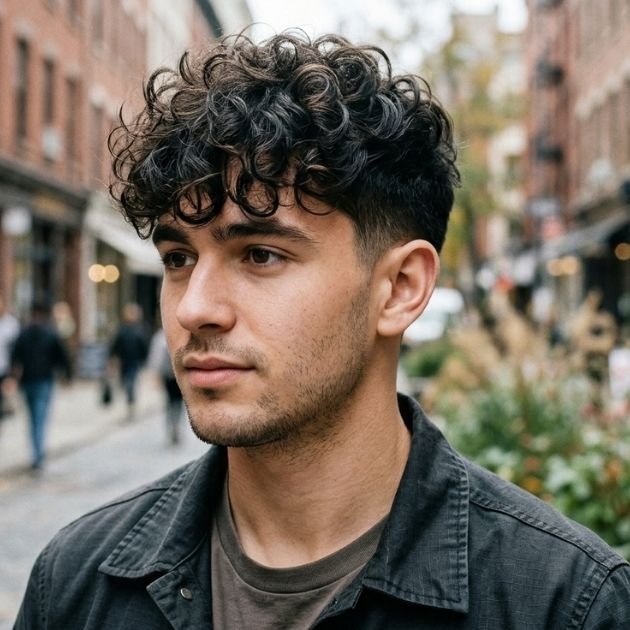
Curls fall forward in loose pieces above a mid taper that keeps the sides neat. The contrast looks intentional and clean.
- Best for: Type 3A to 4A curls
- Styling: Curl cream or leave-in conditioner on wet hair, scrunch, diffuse
- Watch out: Ask for the top to be cut dry or while the curls are in their natural shape so the length lands where you expect
Side-Swept Textured Fringe
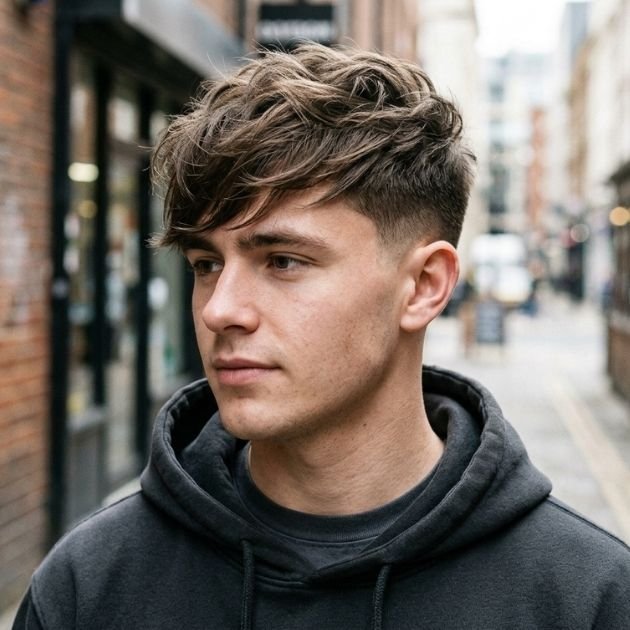
The fringe sweeps to one side instead of falling straight. It gives a slightly more polished finish and suits an office as easily as a night out.
- Best for: Men who want a cleaner look with a natural part
- Styling: Medium-hold clay, comb through once, then break it up with fingers
- Why it works: The diagonal line softens a strong jaw or a wide forehead
Textured Fringe with Design
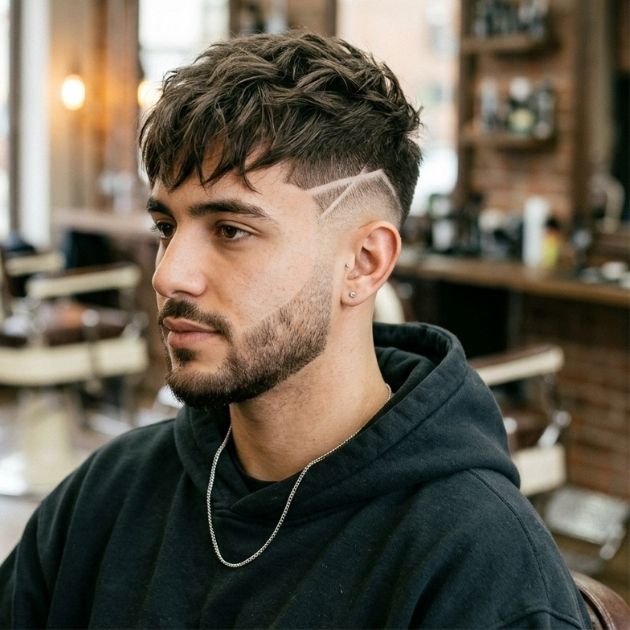
This version adds a shaved line, a parting cut or a small pattern in the taper. It is the most personal option, and the one that needs the most upkeep.
- Best for: Confident dressers who see their barber every two to three weeks
- Styling: Keep the top simple so the detail does the talking
- Watch out: Designs grow out fast, so book your next visit before you leave
See Also: 10 Best Mid Taper Fade Middle Part Styles for Men (2026)
Mid Taper Fade Textured Fringe Explained: What Makes the Texture Work
The cut has two parts, and each does a different job.
The mid taper. The sides start short at the neckline and gradually lengthen. The fade line sits around the temple, roughly halfway up the head. A taper keeps some length at the edges, so it looks softer than a skin fade.
The textured fringe. The top is cut with point cutting, slide cutting or a razor so the ends are uneven. Uneven ends separate into pieces. Pieces catch product and create that lived-in look.
Texture comes from the cut first and the product second. If the barber leaves the top blunt, no amount of clay will fake it. That single point explains most of the disappointment men report after a haircut.
Here is what the texture relies on:
- Length: 2 to 4 inches gives enough weight to move
- Layering: Shorter pieces inside, longer pieces on the surface
- Disconnection: A visible step between top and sides adds contrast
- Dryness: Product works best on hair that is not greasy or freshly conditioned
Why Textured Fringe Is Still Everywhere in 2026?
Trends usually fade within two seasons. This one has stayed for a few reasons.
- It suits real life. Most men want a cut that looks fine after a gym session, a commute and a meeting.
- It is adaptable. The same base works on straight, wavy and curly hair, so barbers can customise instead of copying a template.
- The mid taper is the safe middle. A high fade can feel loud, and a low taper can feel too subtle. The mid sits between them.
- Shorter styling time. Most men finish in under three minutes once the cut is right.
- It carries across ages. Teenagers, students and professionals all wear it, just with different lengths.
Social media made the look visible, but its staying power comes from practicality. A style that is easy to wear tends to outlast a style that is easy to photograph.
Pros and Cons: What You’re Signing Up For
Pros
- Looks styled with very little effort
- Works with most hair types and densities
- Easy to dress up or down
- Grows out fairly gracefully
- Hides thinning at the front better than a slicked-back cut
Cons
- The taper needs a refresh every three to four weeks
- Fine, flat hair may need more product and a blow dryer
- Cowlicks at the front can fight the fringe direction
- Poor point cutting leaves the top looking messy rather than textured
If you can commit to a barber visit once a month, the upside is much larger than the downside.
Choosing by Hair Type: What Actually Holds Texture
Straight Hair
Straight hair shows every cutting mistake, so ask for point cutting and keep the top around 2 to 3 inches. Use sea salt spray before clay to add grip. Without it, straight hair tends to slide back into a flat curtain.
Wavy Hair
Wavy hair is the easiest match. Keep the top slightly longer, around 3 to 4 inches, so the wave has room to form. Use a light cream and avoid heavy gel, which flattens the pattern.
Thick Hair
Thick hair needs weight removal. Ask your barber to texturise the inside layers so the fringe does not puff outward. A strong clay or paste keeps the shape from expanding by afternoon.
Curly Hair
Curly hair works best when the barber respects the natural pattern. Leave 3 to 5 inches on top, tell the barber your curl type, and moisturise daily. Dry curls look frizzy, not textured.
Face Shape Matchups
Face shape guidance is a starting point, not a rule. Use it to adjust fringe length and volume.
Oval Face
Almost everything works. Try the classic or side-swept version and keep the fringe at mid forehead.
Round Face
Add height and keep the sides tight. A volume-focused fringe with a mid taper lengthens the face. Avoid a heavy, flat fringe that adds width.
Square Face
The choppy or classic fringe softens a strong jaw. A slightly side-swept finish helps break up straight lines.
Heart-Shaped Face
Choose a fringe that falls to eyebrow level, which adds balance to a narrow chin. Skip extreme height at the crown.
Long Face
Keep the top shorter and the fringe forward. Too much height makes the face look longer. The wavy or classic version at 2 to 3 inches works well.
Diamond Face
A fringe across the forehead adds width where you need it. Pair it with moderate volume and avoid sharp, high sides.
Rectangular Face
Go for a forward fringe with medium length and little lift. The aim is to shorten the visual height of the forehead.
Age Group Breakdown
Teenagers
Teens can handle the choppy, high-texture version with more length at the front. The mid taper gives a school-friendly outline, and the top shows personality. Keep styling simple, since consistency matters more than complexity.
Young Men
In the 20s, the blowout, curly and design versions all work. This is the age to experiment with length, colour and detailing. Pair it with a beard for extra structure if you like.
Professional Men
Choose the classic or side-swept fringe, with the top trimmed a little shorter at 2 to 3 inches. Use less shine and lighter texture. The result looks tidy in meetings but still modern.
Talking to Your Barber: The Exact Guard Numbers
Guard numbers vary by clipper brand, so treat these as a starting map. A good barber will adjust for your hair density and head shape.
Taper Fade Guard Sizes
- Neckline and ear edges: #0.5 or #1 (about 1.5 to 3 mm)
- Lower sides: #1.5 to #2 (about 4 to 6 mm)
- Mid sides near the temple: #3 (about 10 mm)
- Upper blend point: #4 (about 13 mm)
- Top: Scissor length, 2 to 4 inches (5 to 10 cm)
Say this to your barber:
“Mid taper, starting at a #1 at the bottom and blending up to a #4 around the temple. Leave 3 inches on top, point cut for texture, and keep the fringe long enough to fall forward.”
Bring a photo and mention your cowlick position. It changes how the fringe should be cut.
Common Mistakes That Flatten the Texture
- Cutting the top blunt. Without point cutting or slide cutting, there is nothing to separate.
- Too much length removed. Under 2 inches, you lose the fringe entirely.
- Over-thinning. Thin hair needs weight, not less of it.
- Using gel. Gel locks pieces together and kills movement.
- Styling wet hair with clay. Clay needs dry or towel-dried hair to grip.
- Overwashing. Daily shampoo strips natural oils and leaves hair limp.
- Using too much product. A dime-sized amount is plenty for most heads.
Maintenance Reality Check
Daily Styling
Follow this quick routine:
- Towel dry until damp, not dripping
- Apply sea salt spray or pre-styler
- Blow dry the fringe forward, then lift at the roots
- Warm a small amount of clay between your palms
- Work it through from back to front and finish with your fingertips
Total time is about three to five minutes.
Products That Work Best
- Matte clay: Best for thick, straight or choppy styles
- Sea salt spray: Adds grip for fine and straight hair
- Curl cream: Defines waves and curls without crunch
- Light fiber paste: Good for pieces and flexible hold
- Texture powder: Adds instant lift on fine hair
Pick one hold product, not three. Layering too many products makes hair heavy.
Washing Routine
Wash two to three times a week for most hair types. Oily scalps may need more. Use a gentle shampoo and a light conditioner on the ends only. Curly hair does better with co-washing between shampoos.
Touch-Up Frequency
- Taper and neckline: Every 3 to 4 weeks
- Top texture and length: Every 6 to 8 weeks
- Designs and parting lines: Every 2 to 3 weeks
Book the next visit at the end of each appointment. Barbers fill up quickly on weekends.
Textured Fringe vs Other Fringe Styles
Textured Fringe vs Blunt Fringe
A blunt fringe is cut in a straight, even line. A textured fringe has uneven ends. Blunt looks stricter and more graphic, while textured looks softer and more relaxed. Blunt also shows growth faster.
Textured Fringe vs Edgar Cut
The Edgar cut has a straight, sharply cut fringe and a high-contrast fade. The textured fringe has movement and a smoother blend. Choose the Edgar for bold precision and the textured fringe for versatility.
Textured Fringe vs Curtain Fringe
A curtain fringe parts in the middle and falls to both sides, usually on longer hair. A textured fringe is shorter and falls forward or sideways. The curtain style needs more length and more patience while growing out.
Frequently Asked Questions
What is a mid taper fade textured fringe?
It is a short haircut with a mid-height taper on the sides and a layered, uneven fringe on top. The taper stays clean while the top looks relaxed.
How long should hair be for a textured fringe?
Aim for 2 to 4 inches (5 to 10 cm) on top. Curly hair can go a little longer so the curls have room to fall.
How often should I get a mid taper fade?
Every 3 to 4 weeks keeps the taper sharp. You can stretch the top to 6 to 8 weeks.
What product is best for a textured fringe?
Matte clay works for most hair types. Use sea salt spray first if your hair is fine or very straight.
Does a mid taper fade textured fringe suit thin hair?
Yes, with a lighter cut. Keep the top at 3 inches, skip heavy thinning and use texture powder for lift.
Conclusion
The mid taper fade textured fringe lasts because it solves a real problem: looking put together without spending half an hour on it. The eight styles above give you options for every hair type, from a classic straight fringe to a curly or designed variation.
Start with three decisions: your top length, your hair type and the finish you want. Then walk into the barbershop with the guard numbers and a clear request. Keep the taper fresh every month, use one good product and avoid washing daily.
Do that, and the cut will work for you instead of the other way around.

Abu Huraira is the administrator of Faxhion Crown, a blog dedicated to hairstyles, fashion trends, and personal style. He is passionate about helping readers discover fresh hairstyle ideas, explore modern fashion, and find inspiration for everyday looks. Through Faxhion Crown, Huraira aims to share helpful styling tips, beauty inspiration, and fashion insights that help readers express their individuality with confidence.
3 thoughts on “8 Best Mid Taper Fade Textured Fringe Styles for Men (2026)”