

Straight hair shows every line in a haircut. That is good news if your barber is skilled, and bad news if the blend is sloppy. A mid taper fade for straight hair gives you short, clean sides and enough length on top to part, sweep back or tousle.
This guide compares the three most popular finishes: the side part, the slicked-back top and the textured fringe. You will also find clipper numbers, product advice, fixes for common problems and a simple script to read out at the barbershop.
Quick answer: A mid taper fade starts around the temple and ear level, then shortens gradually toward the neckline. On straight hair it works best with a side part for work and formal settings, a slick back for a sharp evening look, and a textured fringe for a relaxed everyday cut.
Why Does a Taper Works with Straight Hair?
Straight hair lies flat and follows gravity. Curly or wavy hair hides a blend because the texture breaks up the lines. Straight hair does the opposite, so a clean transition looks even sharper.
A taper also solves two problems straight hair often has:
- Weight control: Short sides stop the hair from pushing outward, which keeps the shape narrow and tidy.
- Length on top: You keep enough hair to comb, part or push around.
- Gentle growth: A taper grows out more softly than a skin fade, so it still looks decent in week four.
- Face balance: Shorter sides add height to the head shape, which many men with round or oval faces like.
Compare your preferences first
Before you pick a style, answer these four questions.
- How much time do you have each morning? A side part takes about two minutes. A textured fringe takes about one.
- What is your dress code? Offices and formal events suit a part or a slick back. Creative or casual settings suit a fringe.
- How thick is your hair? Fine hair needs volume products. Thick hair needs weight control and a stronger hold.
- Where is your crown and hairline? A strong cowlick or a receding temple changes which direction your hair wants to go.
If you want the short answer: choose the side part for the most versatile option, the slick back for the boldest one, and the fringe for the lowest effort.
Mid Taper with a Side Part
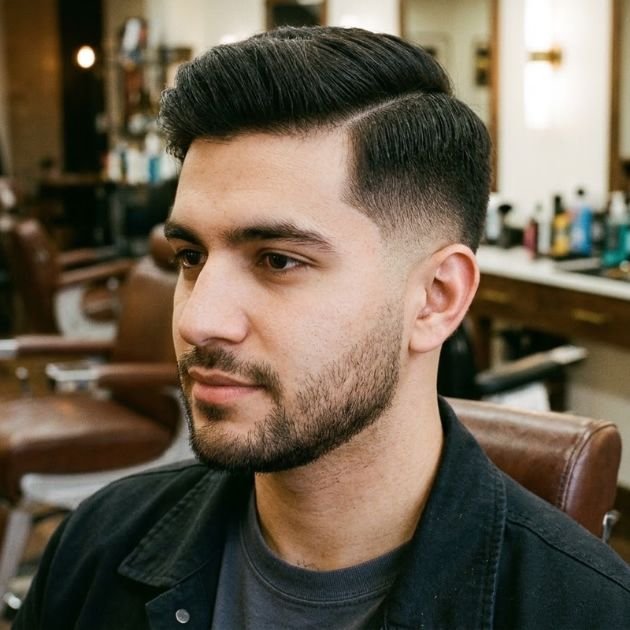
The side part is the classic partner for a taper. The sides stay neat and the top sweeps across in one clean direction. It reads as polished without looking like you tried too hard.
Best for: Office jobs, interviews, weddings and anyone who wants a timeless look. It suits most face shapes, especially oval and square.
Ideal top length: About 3 to 5 cm (roughly 1.5 to 2 inches). Shorter than that and the part will not hold. Longer and the top can flop.
How to style it?
- Start with damp hair. Towel dry until it stops dripping, but leave it slightly wet.
- Find your natural part. Comb the hair straight back, then push it forward with your fingers. Where it splits is usually your best part line.
- Add the product. Rub a pea-sized amount of pomade or light clay between your palms.
- Comb the part. Draw a line with the tip of a comb, then comb the longer side across and the shorter side down.
- Blow dry for lift. Use a medium heat and point the airflow in the direction you combed.
- Finish. Smooth the surface with a comb and add a light mist of spray if you need all-day hold.
Pro tip: Ask your barber to cut the part in while the hair is dry. It shows you exactly where your hair falls, so the part is easier to recreate at home.
Mid Taper with a Slicked-Back Top

A slick back pushes the hair straight back from the forehead. With a mid taper, the contrast between the longer top and the short sides is clean and strong.
Best for: Thick or medium-density straight hair, square and angular face shapes, evening events and anyone who likes a sharper, more dramatic finish.
Ideal top length: About 6 to 10 cm (2.5 to 4 inches). The hair needs enough length to reach the back of the crown without sticking up.
How to style it:
- Apply a small amount of product to towel-dried hair.
- Comb the hair straight back from the hairline, working from front to back.
- Use a blow dryer to set the direction while you comb.
- Check the sides. The hair should sit flat against the taper, not poke out.
- Lock it with a light spray if the weather is humid.
What to watch: Straight hair that is very fine can look thin when slicked back with a heavy product. If that is you, choose a lighter cream or a paste and use less. A visible scalp under shiny pomade is a common mistake.
Mid Taper with a Textured Fringe
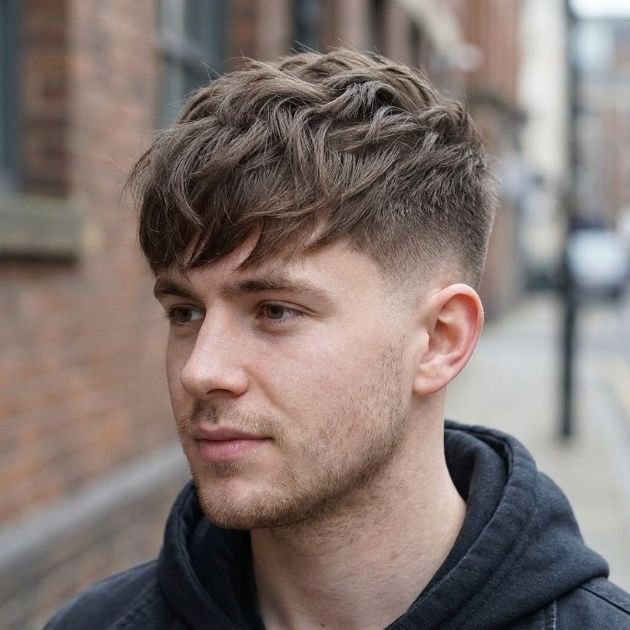
The textured fringe pushes hair forward onto the forehead in a cropped, messy shape. It is the easiest of the three to live with, and it hides a receding hairline well.
Best for: Casual style, younger men, students, and men who want a quick routine. It also helps balance a longer face.
Ideal top length: About 4 to 7 cm (1.5 to 3 inches), cut with scissors and point cutting so the ends look broken up and not blunt.
How to style a textured fringe on straight hair?
Straight hair is slippery, so it needs grip to hold a messy shape.
- Dry first. Blow dry the top forward with your fingers.
- Use a grippy product. Matte clay or fibre paste works better than gel on straight hair.
- Warm the product. Rub it between your hands until it is almost clear.
- Work it through. Push the product from the roots to the tips, then pinch the ends into small sections.
- Set the fringe. Pull the front slightly forward and across, then stop touching it.
A light sea salt spray before the clay adds extra grip and a matte finish.
Best Top Styles for a Mid Taper on Straight Hair
The three options above are the most popular, but a mid taper handles other tops well too. Here is how the main choices compare.
| Top style | Length needed | Effort | Best occasion |
| Side part | 3 to 5 cm | Medium | Work, formal |
| Slick back | 6 to 10 cm | Medium | Evening, events |
| Textured fringe | 4 to 7 cm | Low | Casual |
| Quiff | 7 to 10 cm | High | Statement look |
| Short crop | 2 to 3 cm | Very low | Gym, active days |
| Comb over | 5 to 8 cm | Medium | Smart casual |
If you are unsure, start with a side part. It can be grown into a slick back later, and it works well while your hair length is still changing.
Mid Taper vs Mid Fade on Straight Hair
People use these terms loosely, and barbers do not always agree on the exact line between them. A simple way to separate them is by how short the hair gets.
- Mid taper: The hair shortens gradually, but the shortest point usually stays above skin level. It looks softer and more natural.
- Mid fade: The hair shortens to skin or near skin at the bottom, then blends up. It looks sharper and more contrasty.
On straight hair, a fade shows more visible shaping because there is no curl to blur it. A taper is more forgiving and easier to maintain. Many men choose a taper because it grows out cleanly and suits a professional environment.
Some barbers also describe a taper as a cut that only works around the sideburns and nape, while a fade goes higher on the head. This is why you should always show a photo. A name alone can mean different things in different shops.
Which Clipper Numbers Are Used?
Clipper guard numbers refer to the plastic combs fitted to the clippers. Higher numbers leave more hair. Sizes can differ slightly between brands, so treat the measurements below as a starting point.
| Guard number | Approximate length left |
| 0 (no guard) | Close to skin |
| 1 | 3 mm (1/8 inch) |
| 2 | 6 mm (1/4 inch) |
| 3 | 10 mm (3/8 inch) |
| 4 | 13 mm (1/2 inch) |
A typical mid taper on straight hair often looks like this:
- Bottom of the taper: A 1 or 2 guard, or a clipper without a guard if you want it shorter.
- Middle blend: A 2 or 3 guard, worked upward in small steps.
- Top of the taper: A 3 or 4 guard where the sides meet the longer top.
Barbers also use the clipper lever to make smaller steps between guards. A closed lever cuts shorter and an open lever leaves slightly more hair. This is how they create a smooth blend with no lines.
What to Ask Your Barber?
Barbers work from clear instructions. Vague requests lead to surprises. Use this checklist.
- Name the style: “I would like a mid taper with a side part.”
- Give the starting point: “Start the taper around the temple and ear.”
- Say how short: “I want the bottom at a number 1” or “I do not want to see skin.”
- Describe the top: “Keep about four centimetres on top for a part.”
- Explain the neckline: “Tapered neck, not squared off.”
- Show a photo: A picture of your hair type is worth more than any term.
- Mention your problems: Tell them about a cowlick, thin patch or hair that sticks out.
Read-aloud script: “I would like a mid taper starting at the temple, number 2 at the bottom, leaving about four centimetres on top, with a left-side part.”
Common Straight-Hair Problems
Straight hair behaves differently, and these three issues come up most often.
Visible guard lines
If you can see stripes where one length meets the next, the blend was rushed. Straight hair makes these lines more obvious.
Fix: Ask the barber to blend again with a lever or scissor-over-comb. At home, a light brush and some extra time before styling can soften small gaps. If it keeps happening, find a barber with strong fade experience.
Flat top
Straight hair can lie flat against the scalp, especially after the first few hours.
Fix:
- Blow dry the roots upward before you style.
- Use a volumising powder or a light clay.
- Ask for a bit of layering on top so the hair lifts instead of collapsing.
Sides that stick out
Coarse straight hair can stand off the sides and make the head look wider than it is.
Fix: Ask for the taper to start a little higher, and have the barber cut the sides closer to the head. Comb the sides down while damp and use a bit of product to hold them in place.
Product Choice by Finish
The wrong product ruins a good cut. Use this guide.
- Side part: Water-based pomade or light cream. Medium hold and a natural to slight shine.
- Slick back: Pomade or gel. Strong hold and high shine, or a cream if you want a softer look.
- Textured fringe: Matte clay, fibre paste or sea salt spray. Medium to strong hold and no shine.
- Fine hair: Light paste or powder. Avoid heavy waxes that weigh it down.
- Thick hair: Strong-hold clay or pomade. You need more control, not more shine.
Tips that make a difference:
- Use less product than you think. You can always add more.
- Warm it in your hands first.
- Wash it out at night. Residue clogs follicles and dulls the hair.
- Use a comb for part and slick back, and fingers for fringe.
When Is It Time for a Trim?
A taper loses its shape slowly, but it still needs maintenance.
- Every 2 to 3 weeks: If you like very clean lines or work in a formal setting.
- Every 3 to 4 weeks: For most men with a mid taper.
- Every 5 to 6 weeks: If you do not mind a softer, grown-out look.
Watch for these signs: the neckline looks fuzzy, the part has lost its shape, the sides are puffing out, or the blend looks muddy. When one of them shows up, book your next visit.
Styling Reference
Keep this table as a quick summary.
| Finish | Top length | Product | Hold | Shine | Time |
| Side part | 3 to 5 cm | Pomade or cream | Medium | Low to medium | 2 to 3 min |
| Slick back | 6 to 10 cm | Pomade or gel | Strong | Medium to high | 3 to 4 min |
| Textured fringe | 4 to 7 cm | Clay or paste | Medium to strong | Matte | 1 to 2 min |
FAQ’s
What is a mid taper fade on straight hair?
It is a cut where the sides and back shorten gradually from the temple area down, leaving longer hair on top that you can part, slick back or texture.
Is a side part or slick back better with a mid taper?
A side part is more versatile and easier to style, while a slick back looks bolder and needs thicker hair and more length.
What clipper numbers are used for a mid taper?
Barbers usually work between a 1 and a 4, starting short at the bottom and moving up in small steps.
How long should the top be for a mid taper on straight hair?
Aim for about 3 to 5 cm for a side part, 6 to 10 cm for a slick back and 4 to 7 cm for a textured fringe.
How often should I get a mid taper trimmed?
Most men need a trim every 3 to 4 weeks, or every 2 to 3 weeks for very sharp edges.
Conclusion
A mid taper fade is one of the easiest ways to make straight hair look sharp. The side part is the safest choice, the slick back is the boldest, and the textured fringe is the simplest to maintain.
Pick the one that matches your routine, tell your barber exactly where the taper should start and how much length to leave on top, and choose a product that fits your finish. Book a trim every three to four weeks and your cut will keep its shape.
If you are still undecided, take a photo of each style to your next appointment and ask your barber which one works best with your hair density, hairline and face shape. A good barber will tell you honestly.

Abu Huraira is the administrator of Faxhion Crown, a blog dedicated to hairstyles, fashion trends, and personal style. He is passionate about helping readers discover fresh hairstyle ideas, explore modern fashion, and find inspiration for everyday looks. Through Faxhion Crown, Huraira aims to share helpful styling tips, beauty inspiration, and fashion insights that help readers express their individuality with confidence.